Daily Code WordsVerified
About Game
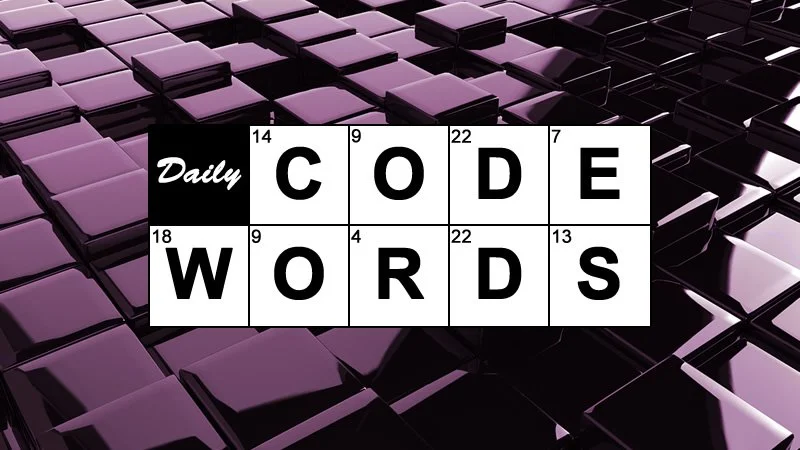
Daily Code Words completely reconstructs the traditional crossword puzzle genre by brutally stripping away all trivia-based clues and definitions, replacing them with a highly logical, cryptogram-style mathematical substitution cipher. Set against a clean, visually minimalist grid that visually resembles a standard crossword, players are presented with a massive grid of blank squares. However, the catch is brilliant: every single white square contains a specific number ranging from 1 to 26. Each number represents exactly one letter of the English alphabet. Your objective is intensely focused and relies entirely on deductive logic and vocabulary pattern recognition: you must decode the numerical cipher to fill the entire grid with valid English words. The game usually provides a starting hint (e.g., "14 = E"). From there, you must use your knowledge of common prefixes, suffixes, and letter frequencies to crack the rest of the code. Offering a fresh, algorithmically generated set of puzzles every day, this is the ultimate brain-training routine for cryptography fans.
How to Play
- The primary objective is to fill the entire crossword grid with valid English words by decoding the numerical cipher.
- The grid is filled with numbers (1-26). Every identical number represents the exact same letter throughout the entire puzzle.
- Use your
Mouseto click on a square in the grid. - Type a letter using your
Keyboardto assign that letter to the selected number. - When you assign a letter (e.g., mapping 'T' to the number '8'), the game will automatically fill in 'T' in every single square marked '8' across the board.
- The Deduction Rule: Use your knowledge of English word structure. If you have a 3-letter word that ends in 'E', and the first number is used frequently throughout the puzzle, it might be 'T' (THE) or 'S' (SHE).
Tips and Tricks
- Leverage the Vowels First (The Golden Rule): The letters E, A, O, I, and U are the most common letters in the English language. Look at the numbers that appear most frequently on the board. One of them is almost certainly 'E'. If a number appears by itself as a single-letter word, it is mathematically guaranteed to be 'A' or 'I'.
- Hunt for Suffixes: Look at the ends of long words. A very common 3-number pattern at the end of a word is often I-N-G or I-O-N. If you suspect a 3-letter sequence is ING, assign those letters and see if it makes sense in the intersecting words.
- Double Letters: Look for identical numbers sitting next to each other (e.g., a word containing '4-4'). The most common double consonants are L, S, T, and P. The most common double vowels are E and O.
- The "Q" Rule: If you discover the letter 'Q', immediately find the number following it and assign it 'U'. This is one of the few absolute guarantees in English cryptography.
- Use Process of Elimination: The game usually displays the alphabet at the bottom of the screen, crossing off letters you have already used. If you need a vowel and 'E' and 'A' are already assigned, your options are drastically narrowed.