Neon MathVerified
About Game
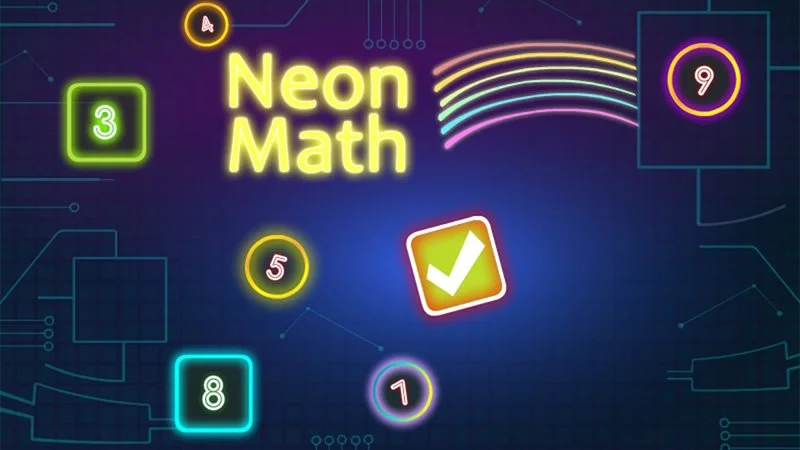
Neon Math fundamentally rewrites the rules of the traditional spatial logic puzzle (like 2048 or Sudoku) by abandoning rigid geometric shape-fitting in favor of a highly complex, free-flowing numerical subtraction system wrapped in a stark, glowing cyberpunk aesthetic. Set against a clean, visually minimalist black grid, players are presented with a series of brightly colored, neon-glowing tiles. Some tiles contain a base number, while others contain specific mathematical operators (e.g., "-2", "-5"). Your objective is intensely focused and brutally unforgiving: you must physically drag the numbered tiles across the grid, colliding them with the operator tiles to systematically reduce their base value to exactly ZERO. The atmosphere is deeply cerebral and immensely satisfying; you are essentially managing a massive game of localized arithmetic while planning complex spatial routes to ensure you have the exact right operators available to zero out every tile. The visual presentation is highly functional, utilizing crisp, high-contrast typography.
How to Play
- The primary objective is to reduce the value of every single numbered tile on the board to exactly zero.
- Use your
Mouseto click and drag a numbered tile (e.g., a tile with the number 7). - Drag it directly onto an operator tile (e.g., a tile that says "-3").
- The Math Rule: The numbered tile will absorb the operator, reducing its value (the 7 becomes a 4). The operator tile is consumed and disappears.
- You must continue routing the numbered tile through various operators until its value hits exactly 0, at which point the tile disappears.
- The Fatal Error: You cannot reduce a tile below zero (e.g., dragging a 2 onto a -5). If you run out of valid operators to zero out all remaining tiles, the level is failed.
Tips and Tricks
- Work Backwards (The Golden Strategy): Do not just start randomly subtracting numbers. Look at a tile (e.g., 9) and look at the available operators (-5, -2, -2). Mentally calculate the exact path required (9 - 5 - 2 - 2 = 0) before you make your first move.
- Share the Operators: In complex levels, you might have two numbered tiles (a 5 and a 4) and a shared pool of operators. You must carefully calculate which tile gets which operator. Giving the -3 to the 5 might leave the 4 mathematically unsolvable.
- Clear the Blockers: Sometimes an operator tile is physically blocking the path you need to take. You might have to temporarily detour a number through that operator just to remove it from the board, even if it wasn't the most mathematically efficient route.
- Order of Operations: The order in which you drag a tile over operators rarely matters in pure subtraction, but if the game introduces multiplication or division tiles, the path sequence becomes incredibly strict.
- Restart Quickly: If you make a mathematical error on your first move, do not try to salvage a broken board. Hit the restart button immediately. This game requires perfect execution.