10 to 20Verified
About Game
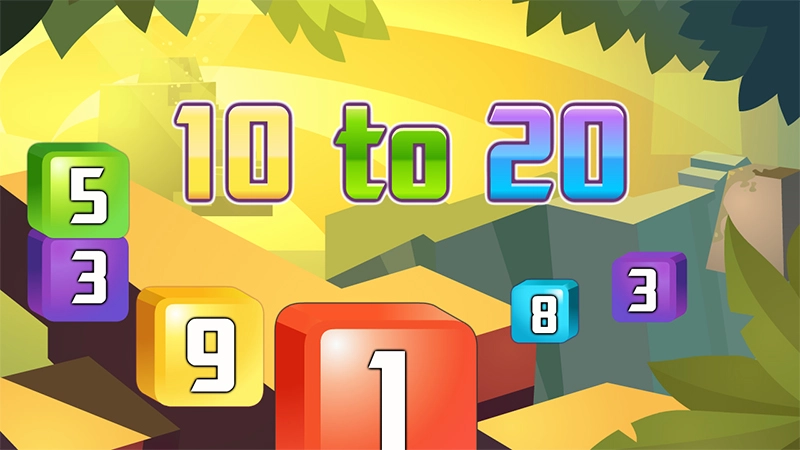
10 to 20 fundamentally rewrites the rules of the traditional numerical sliding puzzle (like the viral hit 2048) by completely abandoning the chaotic, full-board swiping mechanic in favor of a brutally calculating, precision-based drag-and-drop system. Set against a clean, visually minimalist grid, players are presented with a board filled with brightly colored, numbered tiles (usually starting around 10). Your objective is intensely focused and heavily reliant on sequence planning: you must physically drag one specific number directly onto an adjacent, identical number. When they merge, they do not double (like 10 + 10 = 20); instead, they simply increment by exactly one value (10 + 10 = 11). Your ultimate goal is to navigate this incredibly slow, incremental mathematical climb to reach the elusive tile "20". The atmosphere is deeply cerebral and immensely satisfying; you are essentially managing a massive game of localized arithmetic while simultaneously preventing the board from clogging up with unmatchable numbers. The visual presentation is highly functional, utilizing stark typography.
How to Play
- The primary objective is to strategically merge numbers to eventually create a tile with the value of "20".
- Use your
Mouseto click and hold theLeft Mouse Buttonon any numbered tile. - Drag that tile directly onto an adjacent (horizontally or vertically touching) tile of the EXACT SAME number.
- The Incremental Merge Rule: When you merge two identical numbers (e.g., a 12 and a 12), they disappear and a single new tile is created with a value ONE HIGHER than the originals (it becomes a 13).
- The new upgraded tile will spawn in the location where you released your mouse click.
- As you play, new random, lower-value tiles will spawn on the board, constantly threatening to trap your high numbers.
Tips and Tricks
- Control the Corners: Your absolute most critical strategy is designating one specific corner of the grid (usually bottom-right or bottom-left) as the permanent home for your single highest-value tile. Never, ever move your highest tile out of that corner. Build everything else toward it.
- Build the "Snake": To effectively feed your highest tile, you must arrange the board in a descending numerical "snake" pattern leading away from the corner. (e.g., The corner is 15, the tile next to it is 14, the next is 13). This allows for massive, rapid chain reactions.
- Don't Strand the High Numbers: If you accidentally create a 14 in the top-left corner, and your main 15 is in the bottom-right corner, you are in serious trouble. Those two numbers will likely never meet because the physical distance is too great to bridge with smaller tiles.
- Calculate the Spawn: When you merge two tiles, one empty space is created, and usually, a new low-level tile immediately spawns. Always assume the new tile will spawn in the worst possible location. Try to leave your empty space on the outer edges.
- Work Backwards: If you need to make a 14, you need two 13s. Look at your board and figure out exactly how to build the second 13 without destroying your existing setup.