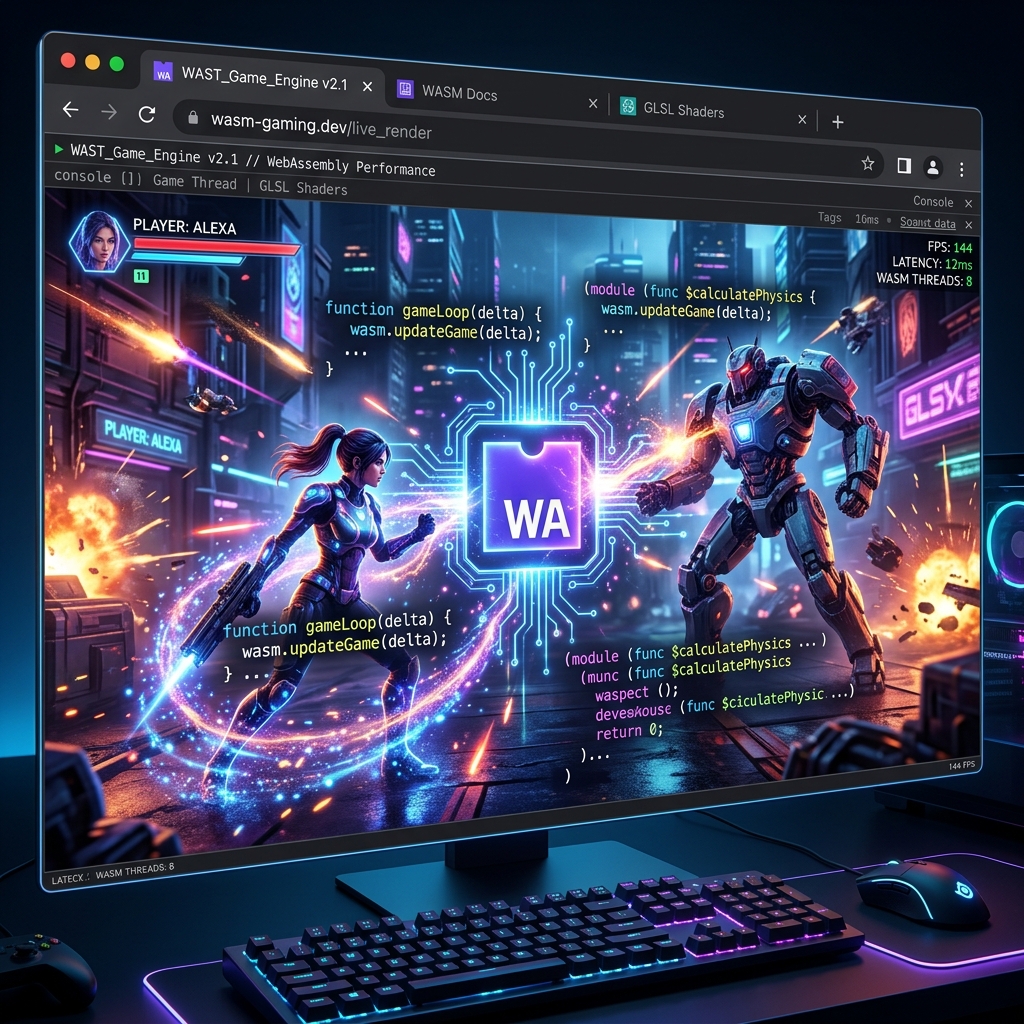

The WebAssembly Game Revolution
For decades, the promise of truly native-quality games running seamlessly within a web browser felt like a distant, almost mythical ideal. Web gaming, while charming and accessible, was long characterized by compromises: simplified graphics, limited physics, and an underlying sense of being a step behind its installed counterparts. From the glory days of Flash to the more recent advancements in JavaScript and WebGL, the web platform consistently struggled to shake off the shackles of performance limitations, memory constraints, and the inherent overhead of interpreted languages. It was a landscape where innovative ideas often had to be scaled back to fit the technical envelope, where grand narratives were condensed into bite-sized experiences, and where the most ambitious projects inevitably defaulted to a native client. But a seismic shift has been underway, quietly building momentum, and it’s now poised to fundamentally redefine what "web game" even means. That shift is the WebAssembly game revolution.
The Technical Heartbeat: Wasm's Core Mechanics and Performance Breakthroughs
At its core, WebAssembly, or Wasm, is not a new programming language in itself, but rather a binary instruction format designed as a portable compilation target for high-level languages like C, C++, and Rust. Imagine a highly optimized, compact bytecode that browsers can execute at near-native speeds. This fundamental difference from JavaScript, which is typically interpreted or JIT-compiled on the fly, is the bedrock of Wasm's transformative power for gaming.
Wasm's architecture is a masterclass in efficiency and security. It operates within a sandboxed execution environment, ensuring robust security and preventing malicious code from interacting directly with a user's system. This sandboxing, however, doesn't come at the cost of performance. Wasm modules are pre-compiled into this binary format, which is significantly smaller and faster to parse than typical JavaScript code. When a Wasm module is loaded by a browser, it undergoes an extremely rapid ahead-of-time (AOT) compilation into machine code, often within milliseconds. This AOT compilation is a crucial distinction from JavaScript's Just-in-Time (JIT) compilation model, where code is compiled and optimized during runtime, leading to potential "warm-up" periods and unpredictable performance spikes as the JIT engine analyzes and re-optimizes code. Wasm, by contrast, provides highly predictable performance from the outset, as the heavy lifting of compilation is done upfront, resulting in code that runs with minimal overhead.
This is precisely how Wasm is closing the performance gap between native and web games. Traditional JavaScript, despite significant advancements in browser engines, is fundamentally an interpreted language. It introduces overheads due to dynamic typing, garbage collection pauses, and the constant need for JIT compilation to optimize hot code paths. For computationally intensive tasks like game physics, complex AI, or real-time rendering logic – the very elements that define modern gaming – these overheads become bottlenecks, leading to stuttering, lower frame rates, and a general lack of responsiveness.
Wasm tackles these issues head-on. Its linear memory model allows C/C++ and Rust programs to manage memory directly, bypassing the often unpredictable pauses associated with JavaScript's garbage collector. This fine-grained control over memory is vital for games where every millisecond of frame time counts. Furthermore, Wasm provides a compact, low-level instruction set that maps much more closely to CPU instructions than JavaScript. This means less work for the browser's engine to translate and optimize, leading to significantly faster execution of CPU-bound tasks. Game engines, physics libraries, and AI routines written in performant languages like C++ can now be compiled directly to Wasm with minimal code changes, retaining much of their original speed and efficiency. Coupled with advanced Web APIs like WebGL (and the upcoming WebGPU for even more direct GPU access), Wasm enables web games to tap into hardware acceleration in ways previously reserved for native applications, rendering high-fidelity 3D graphics and complex visual effects with unprecedented fluidity. The result is a dramatic reduction in the performance disparity, blurring the lines between what’s possible in a browser and what requires a dedicated desktop application. This technical prowess fundamentally underpins the entire revolution.
Unlocking New Gameplay Frontiers: Speculation and Possibilities
The newfound performance capabilities of WebAssembly aren't just about making existing web games run faster; they're about enabling entirely new genres and levels of complexity within the browser. The creative floodgates are opening, allowing developers to pursue ambitions previously deemed impossible.
Imagine a game where complex physics simulations are no longer approximations but detailed, real-time calculations. Players could witness buildings collapsing with realistic debris, fluid dynamics accurately modeling water flow or smoke dispersal, or intricate mechanical systems interacting with genuine physical properties. This could lead to sandbox games with unprecedented emergent gameplay, puzzle games where environmental manipulation is profoundly realistic, or even action titles featuring destructible environments that genuinely alter combat scenarios. We could finally see the "next-gen" physics engines that have long been exclusive to native clients making their debut directly in your browser tab.
Beyond physics, Wasm empowers advanced AI and sophisticated pathfinding. No longer would NPCs be limited to simple patrol routes or predictable behaviors. Developers could implement complex decision-making algorithms, large-scale crowd simulations with individual pathfinding, or even deep learning models for adaptive enemy AI. This translates to more believable, challenging, and dynamic game worlds. Think grand strategy games with truly intelligent factions, RPGs where companions react contextually to changing situations, or even complex simulation games managing vast economies and political landscapes, all running client-side in the browser.
The impact on graphics and rendering engines is perhaps the most visible aspect of this revolution. With Wasm, established, feature-rich C++/Rust game engines like Unreal Engine, Unity, and Godot can be (and are being) effectively compiled and run on the web. This means high-fidelity 3D rendering, advanced lighting models, complex shader effects, and massive open worlds are no longer just desktop dreams. We are talking about games visually indistinguishable from their installed counterparts, complete with intricate character models, expansive landscapes, and dynamic weather systems, all streamed and rendered directly within the browser. This dramatically lowers the barrier to entry for players, as there's no installation, no platform-specific clients – just a URL.
Furthermore, multiplayer and networking stand to benefit immensely. Lower latency execution of game logic on the client side can lead to more responsive controls and a smoother experience in competitive online games. Coupled with advancements in WebSockets and potential future server-side Wasm applications (e.g., edge computing for game servers), the dream of high-performance, low-latency multiplayer experiences directly in the browser is becoming a reality, potentially democratizing access to competitive gaming.
Finally, the advent of Wasm opens up exciting avenues for modding and user-generated content. Imagine game developers providing APIs that allow players to write their own Wasm modules for custom game logic, new items, or unique gameplay mechanics. This secure, performant, and sandboxed environment could foster a vibrant ecosystem of community-driven content, extending the life and creativity of games in ways previously only possible with dedicated modding tools for native platforms.
The "Lore" of Web Gaming - A Historical Perspective and Future Narratives
To truly appreciate the WebAssembly revolution, one must consider the historical "lore" of web gaming – a narrative shaped by technical limitations and the creative solutions they demanded. For years, the story of web games was one of compromise. The browser, with its inherent security models and performance overheads, was a hostile environment for ambitious game designs. Flash games, while incredibly popular, were confined by the ActionScript language and the Flash runtime's capabilities, leading to distinct visual styles and gameplay loops that often prioritized immediate gratification and simple mechanics. JavaScript, while more open, battled with its single-threaded nature, garbage collection, and the sheer computational cost of running complex algorithms.
These technical constraints weren't just hurdles; they were narrative constraints. They forced developers to tell simpler stories, create smaller worlds, and limit the scope of player agency. The "lore" of web games often revolved around short, arcade-like experiences, puzzle games, or text-heavy adventures, because detailed simulations, expansive environments, and deeply branching narratives were simply too taxing for the platform. Game designers became masters of efficiency, but often at the cost of unbounded artistic vision.
Wasm changes this narrative entirely. It's an enabler of epic stories. With the ability to handle complex computations, render high-fidelity graphics, and manage vast amounts of data, developers are no longer forced to compromise their vision. This means:
- Deeper, richer lore: Games can now support expansive, persistent worlds with detailed backstories, intricate political systems, and characters with profound personal histories, all rendered and simulated in real-time within the browser.
- More complex branching narratives: Player choices can lead to genuinely divergent plotlines, impactful consequences, and multiple endings, without the computational burden of tracking and managing vast state machines in a less performant environment.
- Massive multiplayer experiences that feel "lived-in": Imagine persistent online worlds where thousands of players interact, build, and tell their own stories within a rich, simulated environment, accessible with just a click. The sheer scale and detail possible could lead to truly emergent narratives driven by player interaction and dynamic world events.
Wasm, in essence, allows the "meta-lore" of the internet – its accessibility, its interconnectedness, its democratizing power – to finally align with the "lore" of the games themselves. It's about breaking free from the technical shackles that once dictated narrative scope, allowing game designers to build worlds and tell stories without the constant whisper of "but can it run in the browser?"
Developer Perspectives: Quotes from the Frontlines
The excitement surrounding WebAssembly isn't just theoretical; it's palpable within the development community. Developers are actively exploring its potential, and their insights paint a vivid picture of the ongoing revolution.
"Before Wasm, porting our C++ engine to the web was a nightmare of polyfills, compromises, and a constant battle against performance bottlenecks," explains Dr. Anya Sharma, Lead Engine Architect at Quantum Games Studio. "Now, it's almost a direct compile. We can take our highly optimized, battle-tested rendering pipelines and physics solvers, compile them to Wasm, and achieve performance metrics that are astoundingly close to our native desktop builds. The performance uplift is transformative, letting us bring genuine AAA experiences, with all their visual fidelity and complex simulations, directly to the browser. It's not just about speed; it's about fidelity without compromise."
For independent creators, Wasm offers a different kind of liberation. Marco Rossi, the visionary creator behind the upcoming indie title 'Chronos Forge,' shares his perspective: "As an indie developer, the web's reach is unparalleled. The ability to distribute my game globally, instantly, with zero friction for the player, is incredibly appealing. But until Wasm, that reach often came with severe creative handcuffs. I had to simplify my game's physics, scale back my AI, and often sacrifice visual ambition just to make it playable in a browser. Now, I can build the complex simulations, the rich, dynamic worlds, and the intricate gameplay systems I've always dreamed of, knowing that anyone with a browser can play instantly. It’s a game-changer for creative freedom and audience accessibility."
Even at the platform level, the significance of Wasm is recognized as a fundamental shift. Elena Petrova, a prominent Web Platform Advocate at Global Tech Innovations, emphasizes the broader implications: "Wasm isn't just a technology; it's a paradigm shift for the entire web ecosystem. It's about bringing the full power, performance, and security of native applications to the web, fundamentally blurring the lines between what’s 'installed' and what’s 'online.' For gaming, this means a truly universal platform, free from burdensome installs, operating system barriers, and complex hardware compatibility issues. It democratizes access for players and empowers developers to reach unprecedented audiences with their most ambitious creations. We're building the future of the web, and gaming is a massive beneficiary."
The Road Ahead: Challenges and the Future Ecosystem
While the WebAssembly game revolution is in full swing, it's important to acknowledge that the journey is ongoing. There are still challenges to overcome and exciting developments on the horizon that will further solidify Wasm's position.
One of the primary challenges has been the evolution of debugging tools. While significant progress has been made, debugging complex C++ or Rust code compiled to Wasm within a browser environment can still be more cumbersome than debugging native applications. However, browser vendors and tool developers are rapidly improving this aspect, offering better source map support and integrated debugging experiences.
Another area of ongoing development is the seamless integration with existing web APIs. While Wasm excels at raw computation, interactions with the DOM, WebGL, WebSockets, and other browser features still often require a thin JavaScript layer. Optimizing this interoperability and providing more direct, performant Wasm-to-Web API bindings is a continuous effort. Furthermore, efficiently handling larger game assets like textures, models, and audio remains a crucial aspect. Streaming technologies and intelligent asset management systems are vital to ensure that even massive browser-based games load quickly and efficiently.
Looking to the future, the horizon is incredibly bright. The most significant upcoming development is WebGPU. While WebGL has been instrumental, WebGPU offers a lower-level, more modern API for accessing GPU capabilities, mirroring native APIs like Vulkan, DirectX 12, and Metal. This will unlock even greater graphical fidelity, more complex rendering techniques, and significantly better performance for GPU-bound tasks in web games, truly bringing them to par with their native counterparts.
Beyond the browser, WASI (WebAssembly System Interface) is extending Wasm's reach, allowing it to run securely and portably outside the browser environment, on servers, IoT devices, and even as serverless functions. This could lead to fascinating synergies, where game logic developed for the browser can be reused on the server for authoritative simulation or cloud gaming scenarios, further blurring the lines between client and server. The integration of Wasm with Progressive Web Apps (PWAs) also promises offline play capabilities and a more app-like experience, allowing players to "install" web games directly to their device's home screen. The combination of Wasm, WebGPU, and PWAs creates a formidable platform for next-generation interactive experiences.
Conclusion: A New Golden Age for Web Gaming
The WebAssembly game revolution is not merely an incremental improvement; it is a fundamental paradigm shift that redefines the capabilities and potential of web gaming. By closing the performance gap with native applications, enabling complex physics and AI, facilitating the porting of high-fidelity game engines, and fostering new avenues for creativity and accessibility, Wasm has shattered the preconceived limitations of the browser. It has transformed the web from a charming but constrained sandbox into a powerful, universal platform for truly ambitious and immersive interactive experiences.
We are entering a new golden age where the convenience of instant, no-install access meets the uncompromised quality and depth previously reserved for dedicated clients. From indie darlings pushing the boundaries of emergent gameplay to AAA blockbusters delivered directly to your browser tab, WebAssembly is laying the foundation for a future where the world of gaming is more accessible, more dynamic, and more inclusive than ever before. The revolution is here, and it’s being played out in a browser near you.