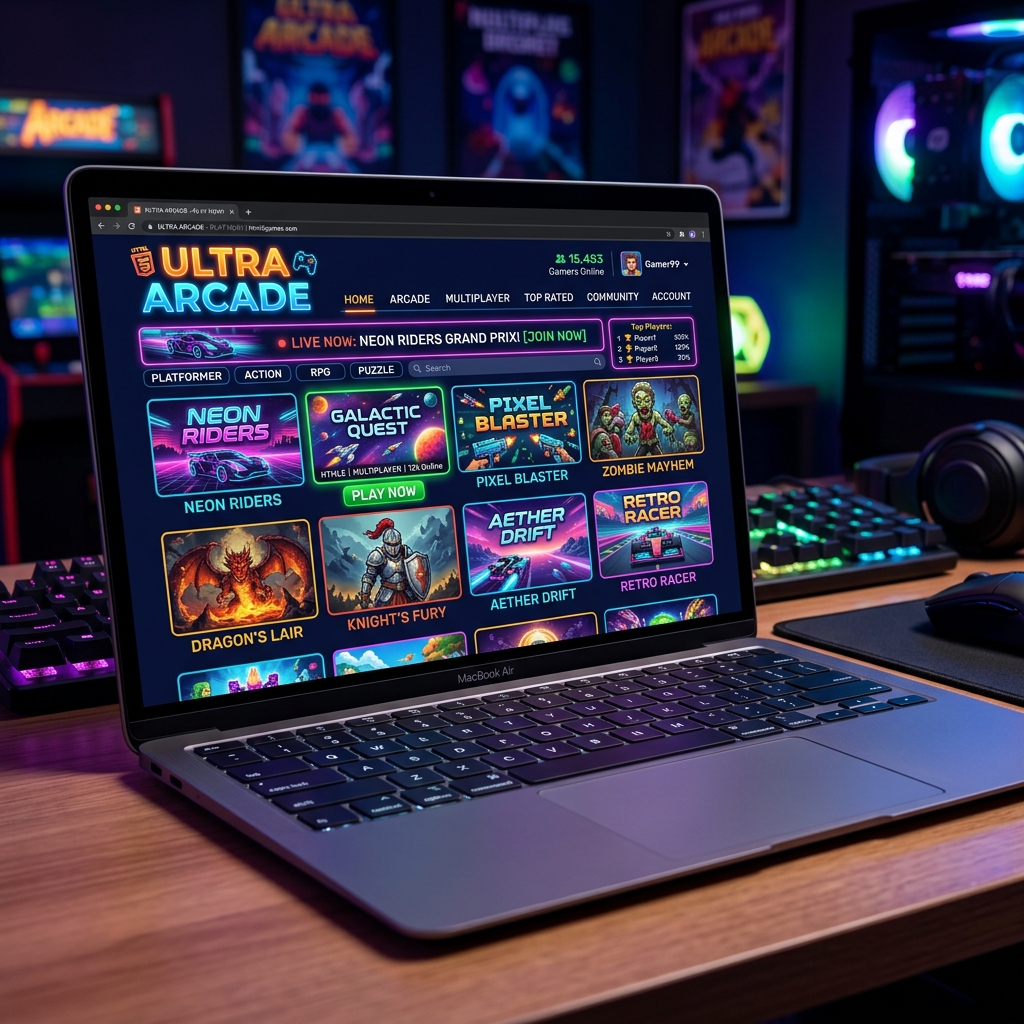

The Unseen Revolution: Why Free Web Games are Dominating in 2026
The year is 2026, and the gaming landscape has undergone a seismic shift. While AAA titles continue to push the boundaries of photorealism and narrative depth on high-end consoles and PCs, an equally compelling, yet far more accessible, revolution has quietly been brewing in the browser. Gone are the days of rudimentary Flash animations and simplistic Java applets; today’s free web games are sophisticated, deeply engaging experiences, leveraging cutting-edge web technologies to deliver instant gratification without the burden of downloads, installations, or hefty price tags. They represent the pinnacle of accessible entertainment, proving that innovation isn't solely reserved for the most expensive corners of the industry. This article delves into the thriving ecosystem of free web games, exploring the technological leaps, the compelling lore that has blossomed around even the simplest concepts, and the immersive gameplay that defines the genre in this vibrant new era.
The Renaissance of Instant Play: A New Era for Browser Gaming
The resurgence of free web games by 2026 isn't merely a nostalgic throwback; it's a testament to rapid technological advancement and a shift in player priorities. The foundational technologies, WebAssembly (Wasm) and WebGPU, have matured dramatically. Wasm now allows near-native performance for complex game logic directly within the browser, executing C++, Rust, and other compiled languages at speeds previously unimaginable for web applications. Concurrently, WebGPU has unlocked the full potential of modern graphics hardware, enabling sophisticated shaders, intricate particle systems, and real-time lighting effects that rival many desktop applications. This synergy has liberated developers, allowing them to craft experiences that are visually stunning and mechanically deep, all while retaining the fundamental "click and play" simplicity that defines the browser gaming experience. Furthermore, advancements in real-time networking protocols and cloud-based asset streaming mean that even massive, multiplayer online experiences can load almost instantaneously, pulling high-fidelity assets from edge servers with imperceptible latency. AI integration, too, has become a cornerstone, not just for intelligent NPC behavior but for procedural content generation and adaptive difficulty scaling, ensuring endless replayability and tailored challenges.
This technical backbone has fostered a developer philosophy focused on community, rapid iteration, and intrinsic fun. Without the overhead of traditional distribution channels, developers can push updates daily, integrate player feedback in real-time, and experiment with bold new mechanics. "The browser is the ultimate sandbox," explains Dr. Anya Sharma, lead researcher at Quantum Play Labs, a think tank dedicated to web-based gaming. "It democratizes creation and consumption. In 2026, we're seeing games that are not just free to play, but genuinely free to experience in their entirety, with monetization models often tied to cosmetic enhancements or community-driven content creation rather than pay-to-win mechanics. It’s a return to the purest form of gaming: immediate, inclusive, and endlessly creative." This environment has allowed classic concepts to evolve into sprawling, persistent worlds, each with its own rich tapestry of lore and intricate gameplay mechanics.
Featured Games: Deep Dives into 2026's Free Web Game Titans
Let's explore some of the most compelling free web games that are captivating millions in 2026, many of which evolved from the simple, yet addictive, browser games of a few years prior that you could play right now without any downloads.
1. Slither.io: Echoes of the Serpent Lord
Once a simple game of growing a snake by eating glowing pellets, Slither.io has blossomed into Slither.io: Echoes of the Serpent Lord, a profound mythological epic veiled beneath its addictive, competitive gameplay. The core mechanic remains: grow your serpent, outmaneuver rivals, and consume their essence. However, by 2026, the game world is no longer a flat, sterile plane. Instead, players navigate procedurally generated biomes – from the bioluminescent depths of the Abyssal Glow to the treacherous, crystalline caverns of the Shard Wastes. Each environment introduces unique hazards, temporary power-ups that grant fleeting abilities like 'Phasing' through other serpents or 'Sonic Burst' to stun opponents, and environmental puzzles that require cooperative player interaction to unlock rare energy sources. The lore has deepened immensely, positing that the serpents are echoes of ancient, cosmic entities known as the Serpent Lords, trapped in an eternal struggle for dominance within a fractured dimension. Consuming the essence of defeated rivals isn't just about growth; it's about absorbing fragments of their ancestral memories and power, slowly awakening the latent abilities within your own serpentine form. Competitive leagues, known as the 'Ascension Trials,' feature real-time leaderboards and seasonal narratives that chronicle the rise and fall of legendary players, often with their in-game serpent's unique cosmetic design being immortalized.
Technically, Echoes of the Serpent Lord is a marvel of predictive networking and server-side physics. The game engine, built on a highly optimized WebAssembly core, handles hundreds of concurrent players with virtually no lag, anticipating player movements to provide a silky-smooth experience even with high-ping connections. WebGPU renders the dynamically lit environments with stunning fidelity, showcasing intricate scale patterns on serpents and shimmering energy trails. "Our goal was to take that primal, addictive loop and give it a universe," explains Elara Vance, lead designer at Thorium Games. "Players aren't just snakes; they're fragments of forgotten gods. The challenge was to convey that epic scale and mystery while keeping the gameplay instant and intuitive. The browser's evolution has given us the canvas to paint that mythology." The game now supports advanced haptic feedback, allowing players to feel the subtle vibrations of nearby rivals or the exhilarating surge of power-up activation directly through their peripherals.
2. Krunker.io: The Metaverse Frontier
From its humble beginnings as a fast-paced, voxel-based first-person shooter, Krunker.io has exploded into Krunker.io: The Metaverse Frontier, a sprawling, user-generated content (UGC) powerhouse. By 2026, Krunker.io is less a single game and more an entire platform, a digital reality where players don't just participate in combat; they build, trade, socialize, and create entire virtual economies. While the core FPS gameplay remains fiercely competitive across thousands of player-designed maps and game modes, the true innovation lies in its deep integration of persistent player-owned spaces and a robust, blockchain-backed asset marketplace. Players can design and host their own 'Districts' – customizable hubs where they can display unique weapon skins, character outfits, and even host mini-games or social events. The lore revolves around a fragmented, post-singularity Earth, where human consciousness has been uploaded into the 'Krunkerverse' – a digital realm governed by warring corporate factions and rebellious hacker collectives. Every player, every weapon, every map contributes to this ever-expanding narrative of digital survival and self-expression.
The technical prowess behind Krunker.io: The Metaverse Frontier is staggering. Its advanced voxel rendering engine, leveraging WebGPU for dynamic lighting and real-time reflections, allows for incredibly detailed environments that are still lightweight enough to stream instantly. Peer-to-peer networking, facilitated by WebRTC, is heavily utilized for custom map hosting and private server instances, drastically reducing reliance on centralized infrastructure. Furthermore, the game's integrated blockchain ensures true ownership of digital assets, allowing players to buy, sell, and trade unique weapon skins, character models, and even entire Districts on an open market, fostering a vibrant creator economy. "We envisioned Krunker as a canvas, not just a game," states Dr. Kenji Tanaka, CTO of Yendis Entertainment. "In 2026, it's a living, breathing metaverse accessible from any browser. The technical challenges of integrating high-performance FPS gameplay with secure, decentralized asset ownership and massive UGC have been immense, but WebAssembly and WebGPU have been game-changers, allowing us to deliver this vision without compromising accessibility." The platform also features seamless browser-based VR/AR integration, allowing players with compatible headsets to step directly into their customized Districts or competitive arenas.
3. Agar.io: The Sentient Swarm Chronicles
From the seemingly simplistic premise of one cell consuming others to grow, Agar.io has evolved into Agar.io: The Sentient Swarm Chronicles, a profound exploration of microscopic evolution, biological strategy, and emergent intelligence. The game in 2026 is no longer a free-for-all arena but a dynamic, living ecosystem where player-controlled 'proto-cells' must not only consume smaller organisms but also adapt to a constantly changing environment. Different biomes, from the nutrient-rich 'Primordial Pools' to the acidic 'Volcanic Vents,' introduce unique flora and fauna, as well as environmental hazards that demand specialized cell adaptations. Players can now specialize their proto-cells, choosing evolutionary paths that grant abilities such as 'Phototrophic Regeneration' (healing in light zones), 'Acidic Secretion' (damaging nearby cells), or 'Symbiotic Bonding' (temporarily merging with allies). The lore suggests that the cells are fragments of an ancient, sentient microbial intelligence, endlessly replicating and evolving within a cosmic petri dish, striving to achieve a unified consciousness. The goal is no longer just to be the biggest, but to lead your swarm to dominance, influencing the ecosystem and outmaneuvering rival swarms with cunning genetic strategies.
Technically, The Sentient Swarm Chronicles is a marvel of complex AI and real-time fluid dynamics, all running efficiently within the browser. The underlying engine, optimized with WebAssembly, simulates a vast number of AI-controlled organisms, creating a believable and challenging ecosystem. WebGPU renders the intricate fluid simulations and bioluminescent effects with breathtaking detail, making each proto-cell and environmental element feel alive. Advanced algorithms govern the procedural generation of environmental factors and the adaptive behavior of non-player organisms, ensuring that no two game sessions are ever truly alike. "We wanted to elevate Agar beyond a simple arcade experience," explains Dr. Lena Petrova, lead game designer at CellForge Studios. "By 2026, it's a deep strategic simulation, a biological RTS where emergent gameplay is paramount. The narrative of sentient evolution gives players a purpose beyond just growing; it's about shaping a microcosm, about becoming the dominant consciousness. The browser environment allows us to deliver this complex simulation to anyone, instantly." The game also supports experimental brain-computer interface (BCI) controls for players seeking an even more direct connection to their swarm.
4. 2048: The Quantum Convergence
What started as a simple, addictive sliding block puzzle, 2048 has transcended its numerical origins to become 2048: The Quantum Convergence, a mind-bending, multi-dimensional puzzle experience steeped in theoretical physics and cosmic philosophy. By 2026, the game's grid is no longer confined to a single 4x4 plane. Players navigate through interconnected grids representing different quantum dimensions, where merging tiles in one dimension can trigger chain reactions or open wormholes to others. The objective isn't just to reach 2048 but to achieve specific 'Quantum Signatures' – complex numerical patterns that unlock new dimensions, reveal hidden lore fragments about the universe's mathematical fabric, or grant temporary abilities like 'Temporal Rewind' (undoing a limited number of moves) or 'Dimensional Shift' (swapping tiles between grids). The lore posits that the numbers are sentient mathematical constructs, fragments of a cosmic calculation, striving for a singularity of knowledge. Players are 'Convergents,' tasked with guiding these numerical entities towards their ultimate destiny. Cooperative modes allow multiple players to work on interconnected grids, pooling their mental resources to solve truly colossal puzzles.
Technically, The Quantum Convergence relies on highly optimized WebAssembly for its complex numerical processing and state management across multiple grids, ensuring smooth performance even with intricate inter-dimensional calculations. WebGPU renders the minimalist yet elegant UI with subtle particle effects and smooth transitions that visually represent the 'quantum entanglement' of the grids. Cloud-based procedural puzzle generation ensures an endless supply of fresh challenges, with AI-driven difficulty scaling adapting to each player's skill level. "We always saw 2048 as more than just a puzzle; it was a meditation on order and chaos," says Professor Kai Nakamura, lead AI developer for Axiom Games. "In 2026, we’ve given it a philosophical depth, a narrative of mathematical sentience. The browser allows us to deliver this complex, cerebral experience to anyone with an internet connection, instantly, transforming a simple mechanic into a profound intellectual journey." The game even features a 'Cosmic Echoes' mode where players can analyze patterns left by previous players, learning from collective intelligence.
5. Skribbl.io: The Collective Canvas
The beloved drawing and guessing game, Skribbl.io, has transformed into Skribbl.io: The Collective Canvas, a vibrant hub for creative expression and community interaction. By 2026, Skribbl.io is more than just a game; it's a global art studio, an educational tool, and a social platform. The core gameplay of drawing a word and guessing it remains, but the toolset has vastly expanded. Players have access to a sophisticated suite of browser-based drawing tools, including customizable brushes, layers, color palettes, and even basic animation frames, allowing for truly impressive artistic creations within the time limit. AI-powered recognition algorithms are more nuanced, capable of interpreting complex ideas and abstract art, making the guessing process more forgiving and inclusive. The lore centers around the 'Dream Weavers,' an ancient collective that believes collective imagination can manifest reality. Each drawing, each guess, contributes to a 'Global Dreamscape,' an ever-evolving, procedurally generated artwork that showcases the collective creativity of players worldwide. The game hosts themed events, artistic challenges with prestigious in-game rewards, and even 'Master Classes' where renowned digital artists stream their creative process live within the game, teaching techniques to the community.
Technically, The Collective Canvas is a testament to low-latency drawing synchronization and advanced browser-based AI. WebAssembly powers the sophisticated drawing engine, ensuring responsive input and high-fidelity brush strokes across various devices. The AI recognition engine, a testament to federated learning from millions of player drawings, runs partially client-side for immediate feedback and partially server-side for complex interpretations. WebSockets provide near-instantaneous synchronization of drawing strokes and chat messages, creating a seamless collaborative experience. "We always believed in the power of collective creativity," states Maya Singh, Community Director at SketchForge Studios. "In 2026, Skribbl.io is the ultimate expression of that. It's a place where artists, aspiring and professional alike, can connect, create, and inspire each other, all within the effortless reach of their web browser. It's truly a collective canvas for the digital age." The game also features a 'Gallery' mode where players can browse, rate, and comment on the most iconic drawings from past rounds, fostering a sense of artistic legacy.
The Future of Free Web Gaming: Beyond 2026
The trajectory of free web games beyond 2026 looks even more promising. The lines between what constitutes a "browser game" and a "native application" are rapidly blurring. With WebAssembly and WebGPU continuously evolving, alongside the increasing power of client-side hardware, the capabilities of browser-based experiences will only continue to expand. We anticipate deeper integration with cloud gaming services, allowing even more graphically intensive experiences to be streamed directly to the browser with minimal local processing. Monetization models will continue to innovate, moving further away from intrusive ads and towards community-driven content, battle passes for cosmetic items, and optional subscriptions that enhance social features rather than gameplay advantages. The emphasis will remain on accessibility and community, fostering a truly global gaming culture where the only barrier to entry is an internet connection.
Conclusion
In 2026, the free web gaming scene is a vibrant, innovative powerhouse, proving that profound experiences need not come with a hefty price tag or cumbersome installation. From the mythical struggles of Slither.io: Echoes of the Serpent Lord to the boundless creativity of Skribbl.io: The Collective Canvas, these games, many evolved from the instant-play browser titles available today, leverage cutting-edge web technologies to deliver deep lore, sophisticated gameplay, and unparalleled accessibility. They stand as a testament to the power of instant gratification, democratizing gaming and fostering communities around the globe. As technology continues its relentless march forward, the browser will remain a fertile ground for developers to experiment, innovate, and surprise, ensuring that the future of free, accessible gaming is brighter and more expansive than ever before. The revolution has already begun, and it's playing out directly in your web browser, one click at a time.